
Best tool for what
Which AI app builder should you use: Lovable, Bolt, Replit, Base44 or Claude Code?
Pick by what you're building and whether you code. According to the vendors (pages read Oct 20, 2026): Lovable builds full-stack web apps with login and a database and syncs code to Git; Bolt and Replit also build iOS and Android apps; Base44 hosts everything for you. If you can use a terminal, Claude Code edits code in your own repository.
By Found Motive · Published · Latest claim verified . We have not tested these tools ourselves. How to read the labels.
Disclosure. Found Motive has no affiliate links on this page and earns nothing from the tools on it. Where we do have an affiliate link, it is marked next to the link and does not change what we say. How we handle affiliate links.
What is the best AI app builder if you can't code?
It depends on the app. According to the vendors (checked Oct 20, 2026), Lovable, Bolt and Base44 all build web apps with login and a database from plain English, and host them for you. Lovable and Bolt sync code to GitHub; Base44's ZIP export still relies on Base44 to run. Replit Agent also builds and publishes apps from a prompt.
Which AI app builder can make an iPhone or Android app?
Bolt (through Expo) and Replit both document building iOS and Android apps and publishing to the App Store, according to their docs (checked Oct 20, 2026). Base44 also submits to the App Store and Google Play, but its app wraps your web app in a native web view. We found no native-app guide in Lovable's or v0's docs.
Can I take my code with me if I leave?
With most of them, yes. Lovable syncs two ways with GitHub, GitLab or Bitbucket; Bolt, Replit and v0 sync with GitHub, and Replit can download a zip. Base44 exports a ZIP on paid plans but says the code still relies on Base44 to run. With Claude Code, the code is in your own repository from the start (checked Oct 20, 2026).
Lovable vs Claude Code: which should you use for a website?
Lovable is a hosted builder: you describe the app, and it generates and hosts a working project with backend and login. Claude Code is a coding agent that edits code in your own repository from a terminal, IDE or desktop app, so hosting is your choice. Lovable's two-way Git sync lets you start in Lovable and keep editing the same code elsewhere.
Bolt vs Lovable: what's the difference?
Both build full-stack web apps from a prompt and host them. According to their docs (checked Oct 20, 2026), Bolt also builds iOS and Android apps through Expo, starts from Figma or Google Stitch designs, and can import a Lovable project. Lovable syncs two ways with GitHub, GitLab or Bitbucket; Bolt syncs with GitHub.
What breaks in AI-built apps?
In one third-party test (VibeTierList, one run per tool on free plans, Oct 2026), all four apps kept users' data separate, but Bolt's edit buttons appeared only on mouse hover, Base44's sign-up could strand new users, and v0 needed six manual setup steps. Before launch, test on a phone, test login recovery, and check user B can't see user A's data.
Pick X if…
| Pick | …if you |
|---|---|
| Lovable | don't code and want a hosted web app with login and a database that you can sync to Git later. |
| Bolt | want web or phone apps (via Expo) with hosting, database and sign-in in one place, or start from a Figma design. |
| Replit | want native iOS and Android apps built by an agent, with a guided path to the App Store. |
| Base44 | want everything hosted in one place and don't plan to move the app off Base44. |
| v0 | are on Vercel or Next.js and want changes to ship through GitHub pull requests and CI. |
| Claude Code | are willing to use a terminal or IDE and want full control of the code and hosting. |
Comparison
| Criterion | Lovable | Bolt | Replit | Base44 | v0Vercel | Claude Code |
|---|---|---|---|---|---|---|
| What it builds | Full-stack web apps and websites. | Websites, web apps and mobile apps. | Web apps and native iOS and Android apps, built by Replit Agent. | Apps and websites, including design, databases, user management and hosting. | Full-stack web apps; Next.js by default. | Changes to your own codebase: it reads, edits and runs code. |
| Login and database | Built in: backend, database and authentication. | Built-in database with authentication and file storage. | Agent adds a database to your app. | Built in: databases and user management. | Through integrations such as Supabase, Neon or Upstash. | Not a hosted backend; it works on the code in your project. |
| Phone app output | No native-app guide found in Lovable's docs; it describes web applications. | iOS and Android via Expo, with App Store and Google Play publishing. | Native iOS and Android; App Store upload with Replit's Launch feature. | App Store and Google Play; the app wraps your web app in a native web view. | No native-app guide found in the v0 docs we read. | Depends on what you build; no app store tooling of its own. |
| Take your code with you | Two-way Git sync with GitHub, GitLab or Bitbucket. | Syncs commits automatically with a GitHub repo. | Two-way GitHub sync, or download as a zip. | ZIP export on Builder plan and up, but the code "still relies on Base44 to run." | GitHub sync with branches, pull requests and CI. | The code stays in your own repository. |
| Hosting included | Yes: a lovable.app URL with HTTPS, or your own domain. | Yes: Bolt Cloud hosting and domains; Netlify optional. | Yes: publish your app to a live URL. | Yes: a free Base44 URL or a custom domain. | One-click deploys on Vercel. | No: Anthropic describes it as a coding tool for your codebase. |
| Needs coding? | No: you build with natural language, backed by editable code. | No coding knowledge required; code view is optional. | No: you describe the app and Agent writes the code. | No: describe your idea and the AI builds it. | Prompt-based; v0 lists developers, designers and product teams as its audience. | Some: terminal, IDE or desktop app, and you review code changes. |
| Free plan includes | Daily build credits, capped at 30 a month. | Build and publish to a bolt.host URL with a Made in Bolt badge; no custom domain. | Free Mode: chat and build without using Power or Max Mode credits. | You can view your app's code but not edit it. | 7 messages a day. | Not on Claude's Free plan; included in paid plans. |
Lovable
A full-stack AI development platform for web apps, built from plain English.
Strengths
Generates frontend, backend, database, authentication and integrations, "all backed by editable code," according to Lovable.
Two-way Git sync with GitHub, GitLab or Bitbucket, so a developer can keep working in an IDE and deploy anywhere.
Hosting is built in: publish to a lovable.app URL with HTTPS, or connect a custom domain.
Limits
Free-plan daily build credits are capped at 30 per calendar month.
We found no native iOS or Android publishing guide in Lovable's docs; Lovable describes itself as a platform for web applications.
Who it's for: Non-developers and founders who want a hosted web app with login and a database, and the option to hand the code to a developer later.
Bolt
A browser-based AI builder for websites, web apps and mobile apps.
Strengths
"No coding knowledge required," and a code view is there when you want it, according to Bolt.
Builds iOS and Android apps with Expo and covers publishing to the App Store and Google Play.
Bolt Cloud bundles hosting, domains, a database, sign-in, file storage and payments.
Starts from a prompt, a Figma frame, a Google Stitch design, a GitHub repo or an imported Lovable project.
Limits
Bolt says web projects don't easily switch to mobile, so say "mobile app" in your first prompt.
Free-plan sites show a Made in Bolt badge and can't use a custom domain.
Who it's for: Non-coders who want web or phone apps with hosting included, and teams that start from Figma or their own design system.
Replit
A workspace where Replit Agent builds and publishes web and mobile apps from a prompt.
Strengths
Builds native iOS and Android apps, with guides for testing on your phone and uploading to App Store Connect.
Two-way GitHub sync from the Git pane, or download a project as a zip.
Free Mode lets you chat and build without using Power or Max Mode credits.
Limits
In Free Mode you can't pick the model, and Routines don't run.
A copied project doesn't include secrets, the database or deployment settings; you set those up again.
Reported: OpenAI is now the default for Replit Agent, according to TechCrunch. Replit's CEO told TechCrunch that users can still choose Anthropic's Claude or other supported models.
Who it's for: Builders who want web and native phone apps in one place, with a guided path to the App Store.
Base44
An AI app builder that handles design, databases, user management and hosting for you.
Strengths
Describe the idea and the AI builds the app, including databases, user management and hosting, according to Base44.
Scans your app against Apple and Google guidelines and generates the files to submit it to both stores.
A GitHub workflow with branches and pull requests is available.
Limits
ZIP export needs the Builder plan or higher, and the exported code "still relies on Base44 to run."
The phone app is a native web-view wrapper around your published web app.
On the Free plan you can view your app's code but not edit it.
Who it's for: Non-coders who want everything hosted in one place and don't plan to move the app elsewhere.
v0 (Vercel)
Vercel's AI agent for building full-stack web apps, with one-click deploys on Vercel.
Strengths
Defaults to Next.js and connects Supabase, Neon or Upstash databases through the Vercel Marketplace.
GitHub-backed projects publish through branches, previews, pull requests and CI.
Deploy to production in one click, or open a pull request for review.
Limits
The Free plan allows 7 messages a day.
In one third-party test (one run, free plan), v0 took about 15 minutes and six manual setup steps to get a working app.
Who it's for: Developers, designers and product teams already on Vercel or Next.js.
Claude Code
Anthropic's coding agent: it edits code in your own repository from a terminal, IDE, desktop app or the web.
Strengths
Reads your codebase, edits files, runs commands and works with git, so the code stays in your repo.
Runs in the terminal, VS Code, JetBrains, a desktop app and the web.
Limits
Anthropic describes it as an agentic coding tool for your codebase; it does not list hosting, a database or login as built in.
Who it's for: People willing to use a terminal, IDE or desktop app who want full control of the code and hosting. See Codex vs Claude Code for the two-tool decision.
Free prompts
Same app, every tool UNTESTED TEMPLATE
Build a multi-user to-do app with sign-up and login, a database where each user sees only their own tasks, and a public URL. (The same prompt VibeTierList used, so you can compare.)
Admin-only page UNTESTED TEMPLATE
Add a page that only an admin can see, and show me how you're enforcing that.
Phone check UNTESTED TEMPLATE
Make every button usable on a phone; no hover-only controls.
Exit check UNTESTED TEMPLATE
Export or sync this project to GitHub and tell me exactly what isn't included in the export.
Dependency check UNTESTED TEMPLATE
List every third-party service this app now depends on and where its keys are stored.
Put it to work
What we have not verified
- We have not run our own build test; the only test cited is a third party's single run per tool on free plans.
- Which Replit plans include Free Mode: the Free Mode page we read did not say.
- Whether Lovable or v0 can publish native iOS or Android apps: we found no guide in their docs.
- Paid-plan details beyond the free-plan row: check each vendor's pricing page.
- Figma Make, Claude Design, FlutterFlow and Bubble are not covered yet.
Quick answers
What is the best AI app builder?
There is no single best. According to the vendors' docs (checked Oct 20, 2026): Lovable for hosted web apps with Git sync, Bolt or Replit if you also need phone apps, Base44 for all-in-one hosting, v0 for Vercel teams, and Claude Code if you code.
Can AI build an iPhone app without code?
Bolt (with Expo), Replit and Base44 document App Store publishing, according to their docs (checked Oct 20, 2026). You still need an Apple Developer account; Replit's guide covers enrolling.
Lovable vs Bolt: which is better?
Neither outright. Both build and host full-stack web apps from a prompt. Pick Bolt if you also want phone apps through Expo or start from a Figma design; pick Lovable for two-way sync with GitHub, GitLab or Bitbucket.
Lovable vs Claude Code for a website?
Lovable if you don't code and want hosting included. Claude Code if you're comfortable in a terminal or IDE and want the code in your own repo. Lovable's Git sync lets you start there and keep editing the same code elsewhere.
Can I export my code from Lovable?
Yes. Lovable's Git sync keeps project code in your own GitHub, GitLab or Bitbucket repository with automatic two-way sync, according to its docs (checked Oct 20, 2026).
Is vibe coding safe for apps with user data?
No builder guarantees it. Before launch, test on a phone, sign up as a new user and abandon it halfway, check that logout ends the session, and make a second account to confirm it can't see the first one's data.
Free
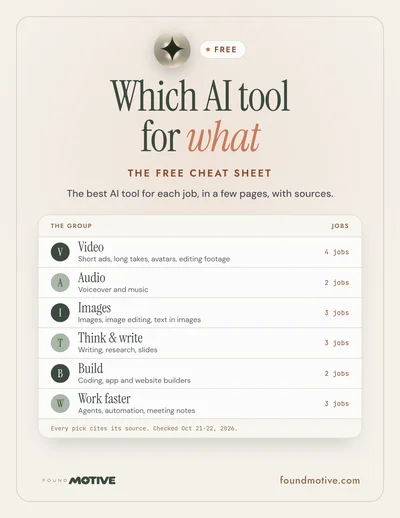
Which AI Tool for What: The Free Cheat Sheet
The best AI tool for each job, in a few pages, with sources.
You’re already subscribed. Get the free cheat sheet
Other jobs